
Table of Contents
Understanding Title Loans: A Comprehensive Guide
A title loan is a short-term, high-interest loan secured by the borrower’s vehicle title. When you apply for these secured loans, the vehicle itself serves as collateral, which distinguishes this borrowing option from other types of credit. Unlike bad credit installment loans, vehicle-title loans require you to pledge your car’s equity as security.
Loans Inc is not a lender. We connect consumers with participating independent lenders and do not make credit decisions, set rates, or determine loan terms. The process is simple: submit our quick online form and, if matched, you may receive offers from independent lenders in our network. For those seeking emergency cash loans, the application is free to apply, carries no obligation to accept an offer, and same-day funding is possible if you are approved by the lender.
Every lender provides a full written disclosure before you sign, detailing all rates, fees, and repayment terms — these are always set by the lender and vary by state. It is critical to understand that a title loan is secured by your vehicle. If you do not repay according to the loan agreement, the lender may repossess your vehicle, and late or missed payments may affect your credit. Title loan availability is not universal; we serve specific states where our matching service is authorized.
If you are considering a title loan, start your free application through our secure Loans Inc lead generation service. Loans Inc is not a lender. We connect consumers with participating independent lenders and do not make credit decisions, set rates, or determine loan terms.
How Title Loans Work: The Basics
A title loan is a short-term secured loan where you use your vehicle’s title as collateral. At Loans Inc, we simplify the process by connecting you with participating independent lenders who may offer the funds you need. Many people turn to title loans when they need quick access to cash and traditional lending options are out of reach.
The first step is completing our streamlined online form. It takes about two minutes, and it is Free to Apply — with No Obligation to accept any offer. After you submit your details, we match you with an independent lender who reviews the age, mileage, and condition of your vehicle, along with your ability to repay. Because the loan is secured by your vehicle, credit checks are often minimal, which helps borrowers with less-than-perfect credit.
Once the lender evaluates your application, they determine the loan amount based on your vehicle’s value, typically ranging from $100 to over $5,000. Repayment terms are most often 30 days, though some lenders offer installment plans. If you are approved, Same-Day Funding Is Possible, and the lender provides a Full Written Disclosure Before You Sign so you understand every term before committing.
To help you see how title loans compare to other borrowing options, the table below highlights the key differences between title loans, personal loans, and payday loans.
| Feature | Title Loan | Personal Loan | Payday Loan |
|---|---|---|---|
| Collateral Required | Yes – vehicle title | Usually none (unsecured) | None |
| Credit Check | Minimal or none in many cases | Typically required; may affect terms | Often not required |
| Typical Loan Amount | Based on vehicle value; averages $100-$5,000+ | $1,000-$50,000+ | $100-$500 |
| Repayment Term | Short-term (often 30 days) with option to renew | 12-60+ months | Due next payday (2-4 weeks) |
| Funding Speed | Same-day possible after approval | Same-day or a few business days | Same-day or next business day |
| Risk of Repossession/Garnishment | Yes – lender may repossess vehicle upon default | No direct asset risk (unless secured) | No asset risk, but may lead to rollover debt cycle |
The primary distinctions center on collateral and credit. Title loans rely on your vehicle’s value, making them accessible even with past credit challenges, while personal loans, as outlined by financial institutions such as Chase, typically require a credit check and offer longer repayment periods. Payday loans provide small amounts with no collateral but demand repayment by your next paycheck, creating a shorter timeline.
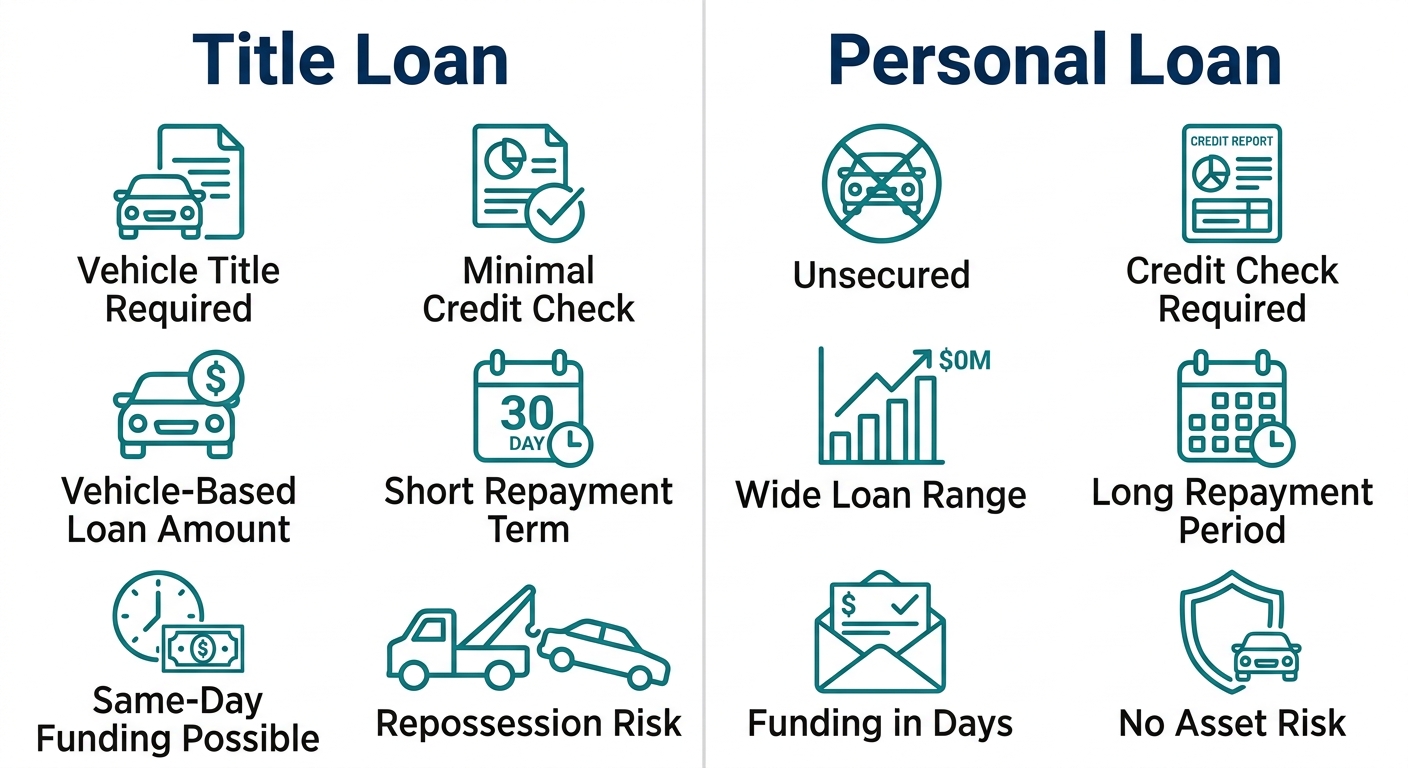
Understanding the risk of repossession is essential. Because a title loan is secured by your vehicle, the lender may repossess your car if you default. According to the Consumer Financial Protection Bureau, late or missed payments may also be reported to credit bureaus. This underscores why we encourage every applicant to review the lender’s terms carefully.
For residents of Delaware, more information on eligibility and local requirements is available on our dedicated page: Title Loans Delaware. Remember, Loans Inc is not a lender. We connect consumers with participating independent lenders and do not make credit decisions, set rates, or determine loan terms. Your application is free, and you are never obligated to accept an offer.
The Mechanics of Vehicle-Secured Lending
Understanding how vehicle-secured lending works can help you navigate your options with clarity. At Loans Inc, we’re not a lender–we connect you with independent lenders–but we believe informed borrowers make better decisions. In this section, we’ll break down the lien process, vehicle valuation, and state-by-state regulations that shape your title loan experience.
Understanding the Lien Process on Your Vehicle
Understanding title loans starts with the lien process. When you agree to a vehicle-secured loan, the lender files a lien with your state’s DMV, establishing a legal claim on your car’s title. According to Chase, this is standard in all secured auto financing, including title loans. The lender holds the physical title certificate, but you keep and drive the vehicle as usual. The DMV records the lienholder’s information, which prevents you from selling or transferring the title until the debt is satisfied. Once the loan balance is paid in full, the lien is released, and the title is returned to you free and clear. It’s crucial to make payments on time; under state laws, the lender can repossess the vehicle if you default. At Loans Inc, we do not place liens or manage title paperwork–we simply connect you with independent lenders who handle the full lien process.
How Lenders Determine Your Vehicle’s Loan Value
Lenders assess several variables to determine how much you can borrow against your car. Key factors include the vehicle’s age, mileage, overall condition, and whether it has a clean title. According to Chase, lenders often consult industry valuation guides like NADA or Kelley Blue Book to establish market value. A clean title is mandatory; vehicles with salvage or rebuilt titles are typically rejected. An in-person or photo inspection verifies the car’s physical state, checking for damage, mileage accuracy, and mechanical soundness, all of which can affect the loan offer. In the title loans industry, lenders generally extend loans equal to 25% to 50% of the vehicle’s wholesale value, not retail. For many consumers, especially those exploring bad credit installment loans, traditional options may be unavailable, so they turn to vehicle-secured borrowing. When an urgent need for emergency cash loans arises, a title loan can provide quick funding, but the amount is tied to the car’s appraisal. These are general industry practices, not guarantees; each independent lender applies its own criteria.
Navigating State-Specific Title Loan Laws
States have their own laws governing title loans, leading to a patchwork of rules that directly affect how much you can borrow and what protections apply. According to the Consumer Financial Protection Bureau, some states limit interest rates, mandate clear disclosures, and set repossession guidelines, while others prohibit vehicle-secured loans entirely. The comparison table below illustrates this variability for four states:
| State | Title Loan Legal Status | Typical Loan Amount Range | Rate Caps / Regulations | Repossession Rules |
|---|---|---|---|---|
| South Carolina | Legal, with regulations | Varies; often $601-$2,500 | Capped rates; state-specific disclosure required | Lender must follow state repossession laws |
| Delaware | Legal; short-term loan law may apply | Up to $1,000 typically | Rate restrictions exist; full disclosure required | Repossession allowed under state law with notice requirements |
| Minnesota | Legal with strict caps | Limited by vehicle value and rate caps | Interest rate caps apply; borrower protections in place | Repossession permitted after default; notice required |
| Colorado | Title loans are generally prohibited | N/A | N/A – law effectively bans high-cost vehicle title loans | N/A |
In South Carolina, title loans South Carolina are legal but come with capped rates and mandatory lender disclosure, helping borrowers compare costs. Delaware permits these loans, often with a maximum of $1,000 and rate restrictions, and lenders must provide full written terms. Minnesota imposes strict rate caps, which can constrain loan amounts but offer consumer protection. Colorado has effectively banned vehicle title loans, so residents must explore other avenues. At Loans Inc, we provide educational insights–we’re not a lender–so we encourage you to verify current laws with your state’s financial agency before applying.
Applying for a Title Loan: Step-by-Step
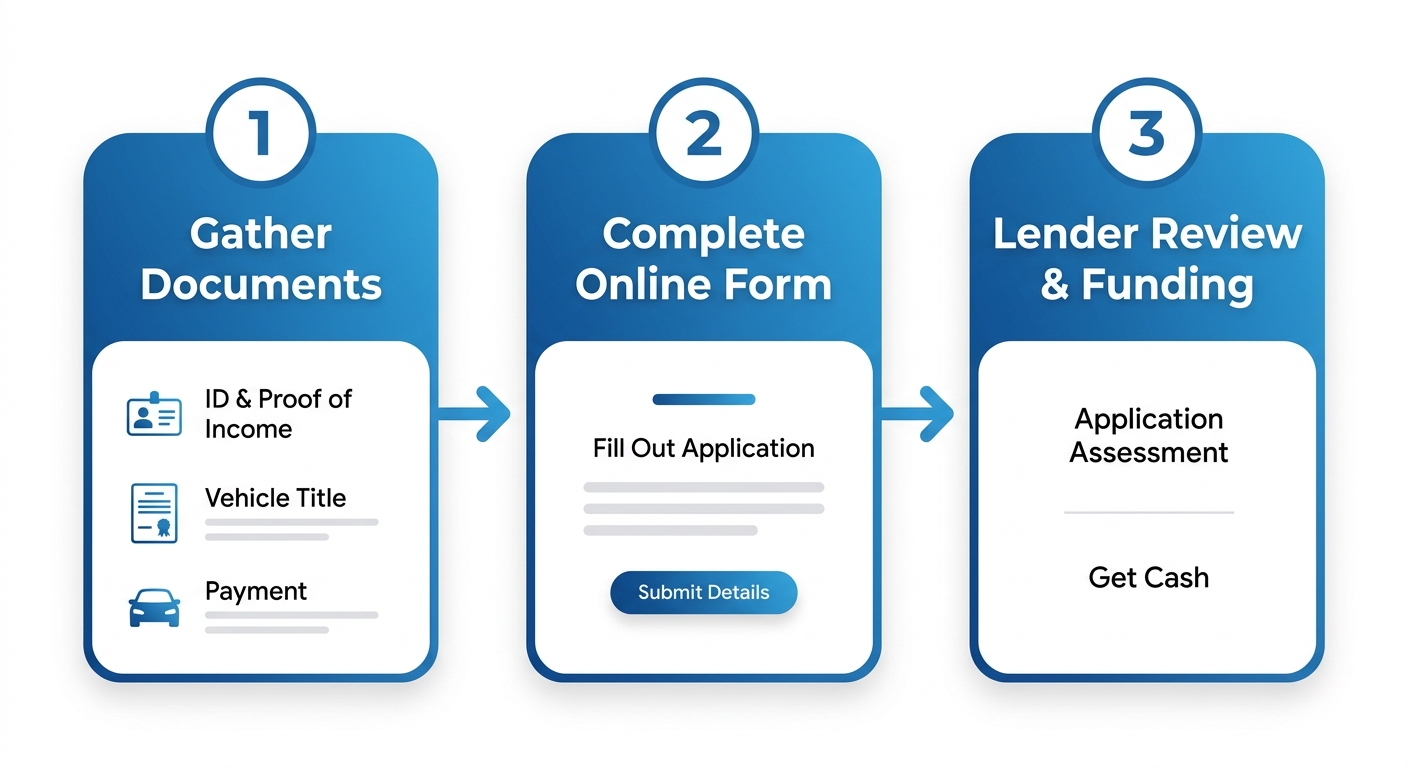
Once you understand how title loans work, the application process through Loans Inc is designed to be straightforward and transparent. We connect applicants with independent lenders who may offer vehicle-secured financing, even if you have less-than-perfect credit. The entire process is free, with no obligation to accept any offer. Here is what to expect when you apply.
Gathering the Required Documents for a Title Loan Application
Before you begin, having the right documents ready streamlines your title loan application. According to the Consumer Financial Protection Bureau, lenders typically require several items to verify your identity, collateral, and ability to repay. Here is what you will need:
- Government-Issued Photo ID: A driver’s license, state ID, or passport confirms your identity and proves you meet the minimum age requirement in your state.
- Original Vehicle Title: The title must be in your legal name and free of any outstanding liens. The lender needs a clear title to secure the loan against your vehicle.
- Proof of Income: Recent pay stubs, bank statements, or tax returns demonstrate that you have the means to repay the loan. This aligns with standard verification practices used by major financial institutions, as outlined by Chase.
- Proof of Residency: A current utility bill, lease agreement, or mortgage statement confirms your address and establishes your eligibility within the lender’s service area, such as for residents in Texas or Illinois.
Preparing these documents in advance ensures a faster, smoother process once you begin the online form.
The following table compares the documentation typically requested for a vehicle-secured title loan versus a bad credit installment loan, both of which may be available through our service.
| Document / Requirement | Title Loan | Bad Credit Installment Loan |
|---|---|---|
| Government-Issued Photo ID | Required | Required |
| Proof of Income | Typically required (pay stubs, bank statements) | Usually required |
| Vehicle Title (Free & Clear) | Mandatory – lender places lien | Not required (unsecured) |
| Proof of Residency | Yes (utility bill, lease) | Yes |
| Vehicle Inspection | May be required (in-person or photos) | Not applicable |
| Social Security Number | Often requested for verification | Often requested |
As the table illustrates, a title loan always requires a vehicle as collateral, while bad credit installment loans do not. Understanding these distinctions can help you choose the option that best fits your situation.
Completing the Online Application: What to Expect
The online application at Loans Inc is free and takes approximately two minutes to complete. You will provide basic personal details, information about your vehicle–such as its make, model, and mileage–and the loan amount you are seeking. There is no cost or commitment to submit your information.
After you fill out the form, we act as a matching service. We do not make credit decisions or set terms. Instead, our matching service (see how loans inc matching works) securely transmits your details to independent lenders who may operate in your state. Each participating lender reviews your application based on their own criteria. At this stage, you are under no obligation and can withdraw at any time before signing a contract.
After You Submit: Lender Review and Possible Funding
Once we forward your application, a lender may contact you to discuss potential terms. In some cases, a vehicle inspection is necessary to confirm its condition and value. This inspection can often be done through photos or a brief in-person review, depending on the lender’s requirements.
If the lender approves your application, they will provide a Full Written Disclosure Before You Sign. This document details the annual percentage rate (APR), fees, repayment schedule, and the total cost of the loan. We urge you to read this disclosure carefully. The title loan is secured by your vehicle, so late or missed payments can affect your credit and may lead to repossession, as noted in guidance from the Consumer Financial Protection Bureau.
Same-Day Funding Possible. Once you sign the agreement, funds can often be deposited directly into your bank account, though timing varies by lender and state regulations.
Now that you understand the application process, we encourage you to explore potential alternatives like emergency cash loans or other unsecured options to find the right financial solution for your needs.
Evaluating Lender Offers and State Regulations
When evaluating title loans, it’s critical to compare offers from multiple lenders carefully. Key factors to examine include the collateral requirement–a title loan is always secured by your vehicle–the repayment period, and total borrowing costs, which lenders set and which vary by state. At Loans Inc, we connect you with participating independent lenders, but we are not a lender ourselves. The matched lender will provide a full written disclosure with all terms before you sign. To protect yourself, verify lender licensing in your state and never sign a disclosure without fully understanding the agreement. Loan approval always requires a complete application and is never guaranteed.
State regulations play a crucial role in whether a title loan is available to you. In Colorado, for example, where title loans colorado illegal, consumers must explore other options entirely. Before applying, we recommend checking your own state’s laws; our site offers state-specific resources to help. Keep in mind that a title loan is secured by your vehicle, and late or missed payments may be reported and could affect your credit. The Consumer Financial Protection Bureau (CFPB) also advises comparing total borrowing costs and confirming that any lender you consider holds a valid license in your state.
For those considering alternatives to title loans, we’ve compiled a quick-reference comparison of three common borrowing options below.
| Feature | Bad Credit Installment Loan | Emergency Cash Loan | Payday Loan |
|---|---|---|---|
| Collateral | Usually none (unsecured) | None in most cases; some may use vehicle title | None |
| Credit Check | Minimal or performed; 500+ scores often considered | Varies; some lenders offer no-credit-check options | Usually no credit check |
| Funding Speed | Same-day to a few business days | Often same-day or next business day | Same-day or next-day |
| Repayment | Fixed monthly installments over several months | Varies; may be lump sum or short-term installments | Lump sum due on next payday |
| Risks | Potential high rates and fees; missed payments affect credit | May carry high interest; rollover risk if terms unclear | Very high APRs; risk of debt cycle |
| Best For | Borrowers who want predictable payments and can handle moderate rates | Those facing unexpected expenses who can repay quickly | Immediate, small-dollar needs but with caution |
As shown, bad credit installment loans typically do not require collateral and offer fixed monthly payments, while emergency cash loans may provide same-day funding with shorter repayment terms. For comparison, traditional banks like Chase offer unsecured personal installment loans that require a credit check and fixed payments, illustrating a different risk profile than title loans. Payday loans, which are often unsecured and carry very high costs, should be approached with caution. With this knowledge, you can confidently evaluate whether a title loan or an alternative fits your situation.
Frequently Asked Questions About Title Loans
Below are answers to common questions about title loans.
What are title loans and how do they work?
Title loans are secured loans where a borrower uses their vehicle’s title as collateral. A title loan is secured by your vehicle. Loans Inc is not a lender — we connect consumers with participating independent lenders who may provide an offer.
Do I need good credit to qualify?
No. Many participating lenders consider applicants with less-than-perfect credit, similar to bad credit installment loans. Lenders evaluate your vehicle’s equity and ability to repay rather than focusing solely on credit scores.
How fast can I get cash?
Same-day funding is possible but not guaranteed. After you complete our free online application and accept a lender’s offer, funds may be available as soon as the next business day. There is no obligation to accept any offer.
What documents are required?
You typically need a government-issued ID, your vehicle’s title in your name, proof of income, and proof of residence. The lender provides full written disclosure before you sign.
Are title loans available in Minnesota?
Yes. Through our network of participating lenders, title loans minnesota options are available to qualified applicants. For more details on availability in your state, see the following section.
Making Informed Borrowing Decisions
When considering title loans or installment loan options for less-than-perfect credit, making an informed choice means understanding the terms and your responsibilities.
- Before any emergency cash borrowing, read the Full Written Disclosure Before You Sign–it details APR, fees, and total cost.
- A title loan is secured by your vehicle; failure to repay may lead to repossession.
- Compare offers by total repayment cost, interest rate, and all charges, not just the monthly payment.
- Loans Inc. is free to apply with no obligation; we do not set rates or guarantee approval–we simply connect you with lenders.
Resources
What to Know Before You Apply
- Who we are: Loans Inc is not a lender. We connect consumers with participating independent lenders. We do not make credit decisions, set rates, or determine loan terms.
- Vehicle risk: A title loan is secured by your vehicle. If you do not repay according to the loan agreement, the lender may repossess your vehicle. Late or missed payments may be reported and may affect your credit.
- Cost: Rates, fees, and repayment terms are set by the lender you are matched with and vary by state. Before you sign, the lender will give you a full written disclosure of the APR, fees, payment schedule, and total cost. Loans Inc does not set or guarantee any loan terms.
- Funding: Many lenders in our network can fund approved loans as soon as the same business day. Timing depends on the lender's approval, when you apply, document verification, and your bank's processing.
- Other options: Lower-cost options may be available. Compare them in our guide to title loan alternatives.
- Your information: When you apply, your application is sent to participating lenders. Read how our matching service works and the difference between a direct lender, a broker, and a lead generator.
Loans, Inc · 495 N IL Route 21, Ste 111, Gurnee, IL 60031 · 847-558-2405 · customersupport@loansinc.com